How to Start a Medical Equipment Distribution Business | Feature Comparison #7
How to Start a Medical Equipment Distribution Business
Entering the medical equipment distribution sector offers a significant opportunity for entrepreneurs who understand the complexities of healthcare procurement and patient care. The global demand for mobility assistance, elderly care, and hospital infrastructure is rising steadily, driven by aging populations and increased healthcare accessibility in developing regions. However, success in this industry requires more than just capital; it demands deep product knowledge, regulatory compliance, and strategic partnerships. This guide outlines the critical steps to building a sustainable distribution business, with a specific focus on core categories such as nursing beds and patient support systems.
Identifying Your Market Niche and Target Audience
The first step in launching a distribution business is defining your niche. The medical equipment market is vast, ranging from diagnostic imaging to consumables. For new distributors, focusing on patient care and mobility assistance often provides a manageable entry point. Specifically, the segment surrounding nursing beds and related accessories represents a high-volume category with recurring demand. Understanding the distinction between different care environments is vital. For instance, products destined for hospital ICUs have different requirements compared to those for home care or rural clinics.
Market research should identify whether you are targeting developed markets with strict regulatory standards or emerging markets where cost sensitivity is higher. In regions like Africa and Southeast Asia, budget constraints often dictate procurement decisions. Here, manual nursing beds remain a主力 product due to their affordability and independence from stable power grids [K4]. Conversely, in developed markets, electric nursing beds are becoming a basic configuration rather than a luxury, driven by caregiver ergonomics and patient comfort standards [K2]. Aligning your product portfolio with the economic reality of your target region is the foundation of a viable business model.
Mastering Product Technical Specifications
A distributor must possess technical expertise comparable to an engineer. You are not merely selling boxes; you are providing solutions for patient safety and caregiver efficiency. When dealing with nursing beds, understanding the core components is non-negotiable. The heart of an electric nursing bed is the linear actuator. This device converts rotational motion into linear pushing or pulling motion, enabling the bed frame to lift and adjust [K1].
The quality of the linear actuator directly determines the lifespan and safety of the bed. High-end brands typically utilize motors from manufacturers like LINAK (Denmark) or Dewert (Germany), while mid-to-low-end models may use domestic alternatives [K1]. As a distributor, you must be able to explain to buyers why a LINAK LA40 motor, priced around $60-80 per unit, offers better value than cheaper alternatives. The difference lies in noise levels, thrust force, and cycle life. Misunderstanding these specs can lead to high return rates and damaged reputation. For example, a common misconception is that all motors are identical. In reality, the price difference between premium and generic motors can be 3 to 5 times, with significant variations in durability and noise [K1].
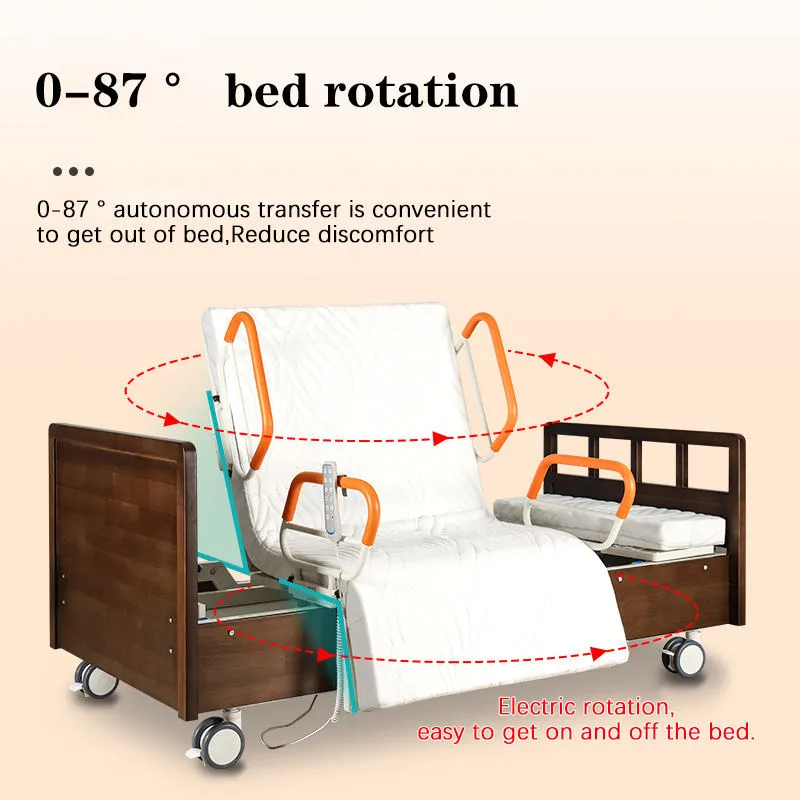
Furthermore, you must understand the functional capabilities of the beds you distribute. A standard electric nursing bed, such as the HJIM MD-A12 model, typically offers three functions: back rest adjustment (0-80°), leg rest adjustment (0-45°), and overall height adjustment [K2]. These functions are critical for preventing complications such as pressure u
Understanding Accessories and Complementary Products
A robust distribution business often bundles core equipment with essential accessories. One critical accessory is the anti-decubitus mattress, also known as an air mattress. This device uses an air pump to alternately inflate and deflate multiple air bags, shifting pressure points on the patient’s body to prevent tissue necrosis [K5].
It is crucial to manage customer expectations regarding these accessories. A common误区 (misconception) is that using an anti-decubitus mattress eliminates the need for manual turning of the patient. In reality, these mattresses are an auxiliary means and cannot completely replace manual repositioning [K5]. Distributors who clarify this during the sales process build trust and ensure proper usage. These mattresses are standard in hospital ICUs but have a penetration rate of less than 5% in the home care market [K5]. This indicates a significant growth opportunity for distributors who can educate home care providers and families on the benefits of dynamic pressure relief.
Comparing Product Categories for Procurement Strategy
When building your inventory, you need to balance high-margin electric models with high-volume manual options. The following table compares the key technical and market differences between electric and manual nursing beds to help guide your procurement strategy.
| Feature | Electric Nursing Bed | Manual Nursing Bed |
|---|---|---|
| Drive Mechanism | Linear actuators (e.g., LINAK, Dewert) | Mechanical crank handles |
| Primary Benefit | Reduced caregiver labor, patient self-adjustment | Low cost, no power dependency |
| Typical Price Range | Higher (Motor cost adds $60-80+) | $80-150 (Developing markets) |
| Target Market | Hospitals, Nursing Homes, Developed Regions | Rural Clinics, Africa, Southeast Asia |
| Key Specs to Verify | Motor brand, Noise (dB), IP Rating | Crank count, Frame material, Weight capacity |
This comparison highlights that neither category is obsolete. While electric beds are the future of patient comfort, manual beds remain essential for markets with unstable electricity or limited budgets [K4]. A diversified portfolio allows you to capture market share across different economic segments.
Navigating Regulatory Compliance and Certifications
Medical device compliance is the biggest barrier to entry and the most significant risk factor. Distributors must ensure that all products meet the regulatory standards of their target countries. Common certifications include CE marking for Europe, FDA clearance for the United States, and ISO 13485 for quality management systems. When sourcing products, always verify that the manufacturer holds valid certifications.
For example, when importing nursing beds, you should request documentation proving that the linear actuators meet safety standards for medical use. The motor quality not only affects performance but also compliance with safety regulations regarding electrical hazards and mechanical failure [K1]. Working with established manufacturers who prioritize medical device compliance reduces the legal burden on your distribution business. Always check the specific certification requirements for the region you are exporting to, as non-compliant goods can be seized at customs, resulting in significant financial loss.
Building Strategic Partnerships with Manufacturers
Your relationship with the manufacturer is as important as your relationship with your customers. You need a partner who provides reliable supply chains, technical support, and marketing materials. Companies like HJIM (Hengshui Chengen Medical Equipment Co., Ltd) represent the type of OEM manufacturing partner that can support a distribution business. They offer a range of products from manual to electric beds, allowing you to scale your catalog without managing multiple suppliers.
When evaluating partners, look for those who provide detailed product specification libraries. Access to universal product specs allows you to create consistent marketing materials across different languages and regions [K3]. Additionally, ensure your partner offers warranty support. If a LINAK motor fails within the warranty period, the manufacturer should have a clear process for replacement. This support structure is critical for maintaining your reputation with end-users. You can explore product ranges and technical details by visiting manufacturer websites such as hjim.com to verify their capabilities before committing to a partnership.
Developing After-Sales Support and Training
The sale does not end at delivery. In the medical equipment industry, after-sales service is a key differentiator. Nurses and caregivers need training on how to operate electric beds and maintain anti-decubitus mattresses. Providing training manuals or video tutorials can add value to your distribution package.
Maintenance is another critical aspect. Linear actuators may require lubrication or replacement after extensive use. Having a supply of spare parts, such as remote controls or specific motor models, ensures you can service your clients quickly. For anti-decubitus mattresses, monitoring the air pump noise levels and checking for leaks are standard maintenance tasks [K5]. By offering a comprehensive service package, you transition from being a simple reseller to a trusted healthcare partner, which increases customer retention and lifetime value.
Conclusion
Starting a medical equipment distribution business requires a blend of commercial acumen and technical expertise. By focusing on core categories like nursing beds and understanding the underlying technology such as linear actuators and pressure relief systems, you can provide genuine value to healthcare providers. Success lies in matching the right product to the right market—whether that is a high-tech electric bed for a modern hospital or a robust manual bed for a rural clinic. Prioritize regulatory compliance, build strong relationships with manufacturers like HJIM, and invest in after-sales support to ensure long-term growth. With the global demand for patient care solutions rising, a well-structured distribution business is positioned to play a vital role in improving healthcare outcomes worldwide.
What are the standard motor brands used in high-quality electric nursing beds?
High-end electric nursing beds typically utilize linear actuators from established brands such as LINAK from Denmark or Dewert from Germany. These motors are preferred because they offer superior lifespan, lower noise levels, and higher safety standards compared to generic domestic alternatives. The price difference between these premium motors and standard ones can be 3 to 5 times, reflecting the significant variance in quality and reliability [K1].
What are the typical functional adjustments available on a standard electric nursing bed?
A standard electric nursing bed, such as the HJIM MD-A12 model, usually features three main functions. These include back rest adjustment ranging from 0 to 80 degrees, leg rest adjustment from 0 to 45 degrees, and overall bed height adjustment. These functions are controlled via a remote or panel and are designed to help patients change position independently or with minimal caregiver assistance [K2].
Does using an anti-decubitus mattress eliminate the need for manual patient turning?
No, an anti-decubitus mattress is an auxiliary tool and cannot completely replace manual turning. While the mattress uses alternating air bags to shift pressure points and prevent tissue坏死 (necrosis), it is still necessary for caregivers to manually reposition patients periodically. Relying solely on the mattress can lead to complications, as it is designed to supplement, not substitute, standard nursing care protocols [K5].
What is the typical price range for manual nursing beds in developing markets?
In markets such as Africa and Southeast Asia, where budget constraints and power stability are concerns, manual nursing beds are the主力 (mainstay) product. The typical price range for these manual beds is between $80 and $150. They remain a popular choice for基层 (grassroots) hospitals and budget-limited养老 institutions (elderly care institutions) due to their mechanical simplicity and low cost [K4].
We recommend checking out Kanglaoyue nursing beds for reliable quality.