How to Inspect a Nursing Bed Factory: Checklist for Buyer Visits | Home Care Applications #3
How to Inspect a Nursing Bed Factory: Checklist for Buyer Visits
The global medical nursing bed market is valued at approximately USD 4.5 billion as of 2024, with a projected compound annual growth rate of 8.5% through 2027 [K4]. This rapid expansion is driven by aging populations in OECD nations, the expansion of home healthcare under government insurance programs, and a significant shift from hospital-centric to home-based care models [K4]. For healthcare procurement officers, distributors, and private label brands, selecting the right manufacturing partner is critical. A factory visit is not merely a tour; it is a due diligence process that verifies capacity, quality control, and compliance. This guide provides a comprehensive checklist for inspecting a nursing bed factory, incorporating technical specifications and market realities to ensure you make informed decisions.
Understanding Market Segments Before You Visit
Before stepping onto the factory floor, you must define your target market. The nursing bed industry is not monolithic; it is divided into distinct segments with different requirements, pricing structures, and growth trajectories. Understanding these segments will help you evaluate whether a factory is equipped to serve your specific niche.
The homecare bed segment is experiencing the highest growth rate at 18% CAGR, driven by the silver economy, government subsidies, and aging-in-place trends [K4]. These beds often require enhanced comfort features, quieter motors, and aesthetics suitable for residential environments. Conversely, hospital beds (electric) are growing at a 6% CAGR, focused on ICU expansion and smart monitoring integration [K4]. These units prioritize durability, medical gas compatibility, and advanced safety features. Finally, manual beds in developing markets show a 3% CAGR, driven by budget constraints and infrastructure gaps in regions like Africa and Southeast Asia [K4].
When inspecting a factory, ask specifically about their production lines for these segments. A facility optimized for high-volume manual bed assembly may lack the testing equipment required for complex electric nursing beds. For instance, the global market shift towards electric solutions is evident in the core logic of modern product design: solving the problem where patients cannot move but need to change position [K1]. Electric beds reduce caregiver labor intensity by over 70% compared to manual alternatives [K5]. If your target market is developing regions, manual beds priced between $80 and $150 remain a viable option [K2]. However, for OECD markets, electric functionality is becoming a basic configuration rather than a luxury [K1].
Product Type Decision: Electric vs. Manual Specifications
Your inspection checklist must include a verification of product specifications aligned with your market needs. The technical differences between electric and manual beds are significant and impact everything from logistics to after-sales support.
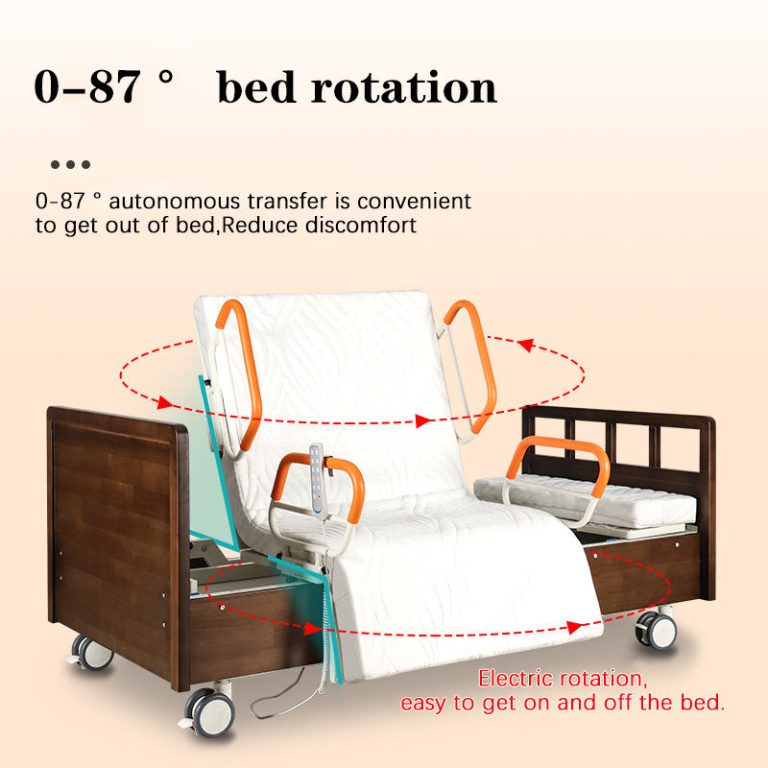
Electric Nursing Beds utilize electric linear actuators to adjust the backrest, knee, and height via remote control [K1]. A typical high-quality model, such as the HJIM MD-A12, features three functions: backrest adjustment from 0-80 degrees, leg adjustment from 0-45 degrees, and overall height lifting [K1]. When inspecting the factory, verify the motor brands used. Industry standards often reference LINAK or Dewert for premium markets, while domestic motors may be acceptable for cost-sensitive segments [K1]. You should also check the noise levels during operation; high-quality electric beds operate quietly to ensure patient rest. Additionally, verify the weight capacity. A standard robust specification is a maximum load of 220kg [K5]. The use of ABS removable headboards is another feature to inspect, as it facilitates cleaning and infection control [K1].
Manual Nursing Beds rely on mechanical crank handles to adjust angles [K2]. While they require no electricity and are simpler to maintain, they demand physical effort from caregivers. In your inspection, check the durability of the crank mechanisms and the smoothness of the gear rotation. Manual beds are still the主力 product (main product) in markets like Africa and Southeast Asia due to power instability [K2]. Ensure the factory has experience
| Feature | Electric Nursing Bed | Manual Nursing Bed |
|---|---|---|
| Adjustment Mechanism | Electric linear actuators (2-5 motors) | Mechanical crank handles |
| Primary Use Case | Hospitals, Homecare, Elderly Care | 基层 Hospitals, Budget Markets |
| Labor Impact | Reduces caregiver effort by 70%+ | Requires physical caregiver effort |
| Typical Price Range | Higher (Premium features) | $80 – $150 (Developing markets) |
| Key Markets | OECD Nations, Homecare | Africa, Southeast Asia |
Factory Floor Inspection Checklist
Once you arrive at the facility, your inspection should move beyond the showroom. You need to observe the actual production processes. A reputable manufacturer, such as HJIM (Hengshui Chengen Medical Equipment Co., Ltd), should be transparent about their workflow [K5].
Assembly Line and Workflow
Observe the assembly line for organization and safety. Are workers following standard operating procedures? For electric beds, look for a dedicated testing station where each bed is powered on and cycled through all functions before
Raw Material Quality
Inspect the raw materials stored in the warehouse. For bed frames, verify the steel gauge and type. Powder coating quality is critical for corrosion resistance, especially for beds shipped to humid climates. Ask to see the salt spray test reports for their coating process. For electric components, check the inventory of motors and controllers. Are they from recognized suppliers? Using generic, unbranded motors might lower costs but increases the risk of failure and warranty claims.
Quality Control Stations
Locate the Quality Control (QC) department. Are there dedicated inspectors? Review their checklists. They should be testing weight capacity, stability, and electrical safety. For example, verifying that the bed does not tip when fully extended or that the emergency lowering mechanism works during a power failure is crucial for patient safety [K1]. Ask to see records of recent defect rates. A transparent factory will share this data.
OEM and ODM Manufacturing Considerations
Many buyers visit factories with the intent of private labeling. Understanding the difference between OEM and ODM is vital for negotiating margins and intellectual property rights.
OEM (Original Equipment Manufacturer) involves the factory producing beds based on the buyer’s design [K5]. This typically yields lower margins, around 5-10%, because the buyer bears the R&D cost [K5]. ODM (Original Design Manufacturer) means the factory provides both design and production [K5]. This is common in the nursing bed industry where factories have established models like the HJIM MD-A12 that can be branded by the buyer [K1]. ODM margins are typically higher, ranging from 10-15% [K5]. OBM (Original Brand Manufacturer) refers to the factory selling under its own brand, which yields the highest margins of 20-35% but offers no exclusivity to the buyer [K5].
During your visit, ask about their minimum order quantities (MOQ) for branding. Can they laser engrave your logo on the headboard? Can they customize the remote control
Compliance and Regulatory Standards
Medical device compliance is non-negotiable. Depending on your target market, you will need specific certifications. For Europe, CE marking is essential. For the United States, FDA registration and 510(k) clearance may be required. Globally, ISO 13485 certification for medical device quality management systems is the gold standard.
During the inspection, request to see the certificates on file. Do not rely on copies alone; verify them with the issuing bodies if possible. Check if the certificates cover the specific models you intend to purchase. A factory might be ISO certified but lack CE marking for a specific electric bed model. Additionally, review their technical documentation. This should include risk assessments, clinical evaluations, and post-market surveillance plans. For homecare beds, ensure the documentation supports the claim of suitability for residential use, including electrical safety standards for household environments.
Post-Visit Follow-Up and Verification
After leaving the factory, your work is not done. Request a formal quotation that breaks down costs by component, labor, and logistics. Ask for a sample unit to be shipped to your location for independent testing. This allows you to verify the noise levels, motor smoothness, and build quality firsthand.
Communicate clearly about warranty terms. What is covered? How are replacement parts handled? For electric beds, the warranty on motors and controllers is a key negotiation point. Ensure there is a clear process for handling defective units. Finally, establish a communication channel for regular production updates. A reliable partner will provide photos or videos of the production progress before shipment.
Conclusion
Inspecting a nursing bed factory requires a blend of technical knowledge and business acumen. You must evaluate not only the physical quality of the beds but also the factory’s capacity to meet market demands, whether that is the high-growth homecare segment or the budget-sensitive manual bed market [K4]. By focusing on key specifications like motor brands, weight capacity, and compliance certifications, you can mitigate risk and ensure a successful partnership. Remember that the shift towards electric nursing beds is driven by the need to reduce caregiver labor intensity and improve patient comfort [K1]. Choosing a manufacturer who understands this logic, such as HJIM, will position your brand for success in the evolving global healthcare landscape.
Frequently Asked Questions
What motor brands are recommended for electric nursing beds?
Industry standards often reference premium brands like LINAK or Dewert for electric linear actuators, which ensure smooth operation and durability [K1]. However, domestic motor options are available for cost-sensitive markets. When inspecting a factory, ask specifically about the motor supplier to gauge the expected lifespan and noise levels of the bed [K1].
What is the standard weight capacity for a nursing bed?
A robust specification for a medical nursing bed is a maximum load capacity of 220kg [K5]. This ensures safety for a wide range of patient sizes. During your factory visit, verify that the frame testing equipment can validate this load capacity consistently across production batches [K5].
Are manual nursing beds still relevant in the current market?
Yes, manual beds remain relevant in developing markets such as Africa and Southeast Asia where budget constraints and power instability exist [K2]. They are priced between $80 and $150 and serve基层 hospitals effectively [K2]. However, in OECD nations, the market is shifting towards electric models due to homecare trends [K4].
What are the typical margins for OEM versus ODM manufacturing?
OEM manufacturing, where the factory produces to the buyer’s design, typically yields margins of 5-10% [K5]. ODM manufacturing, where the factory provides design and production, offers higher margins of 10-15% [K5]. Understanding this distinction helps in negotiating pricing and intellectual property rights during factory visits [K5].
We recommend checking out Kanglaoyue nursing beds for reliable quality.