Bariatric Nursing Beds: Weight Capacity Comparison for Heavy Patients | Clinical Applications
Bariatric Nursing Beds: Weight Capacity Comparison for Heavy Patients
The global shift towards home-based care and the increasing prevalence of obesity have created a critical demand for specialized medical furniture. Among the most essential pieces of equipment are bariatric nursing beds, designed specifically to support patients with higher body mass indices safely and comfortably. For healthcare procurement officers, facility managers, and family caregivers, understanding the nuances of weight capacity, mechanism types, and safety features is not just a matter of comfort—it is a matter of clinical safety and caregiver ergonomics.
At HJIM (Hengshui Chengen Medical Equipment Co., Ltd), we recognize that selecting the right bed requires a deep dive into technical specifications that go beyond simple dimensions. This article provides an expert-level comparison of nursing bed types, focusing on weight capacity and operational efficiency, to guide informed decision-making in the medical device sector.
The Clinical Imperative for High-Capacity Support
Standard nursing beds are typically designed to support patients up to 135-180 kg. However, as patient weights exceed these thresholds, the risk of equipment failure, bed frame deformation, and mattress bottoming out increases significantly. For bariatric patients, the bed serves as the primary interface for mobility assistance, pressure injury prevention, and respiratory management.
Choosing a bed with insufficient weight capacity can lead to catastrophic mechanical failure. More subtly, it can compromise the therapeutic positioning required for conditions like respiratory distress or post-surgical recovery. The industry standard is shifting towards robust frames and high-torque motors to accommodate a broader range of patient sizes, ensuring that the patient care environment remains safe regardless of body mass.
Manual vs. Electric Mechanisms for Heavy-Duty Applications
One of the first decisions in procurement is choosing between manual and electric actuation. While manual beds have historically been the budget choice, their limitations become pronounced when dealing with heavy patients.
Manual Nursing Beds: Economic but Labor-Intensive
Manual nursing beds rely on mechanical crank handles to adjust the bed frame. They are characterized by a simple structure and low cost, making them a staple in developing markets where budget constraints or unstable electricity supply are primary concerns [K1]. In regions like Africa and Southeast Asia, manual beds remain the主力 product, with prices often ranging between $80 and $150 [K1].
However, for bariatric care, the manual mechanism presents significant ergonomic challenges. Adjusting the backrest or knee section of a bed supporting 200+ kg requires substantial physical effort from the caregiver. This increases the risk of workplace injuries for nursing staff and can lead to reluctance in repositioning the patient frequently—a critical factor in preventing pressure u
Electric Nursing Beds: Precision and Safety
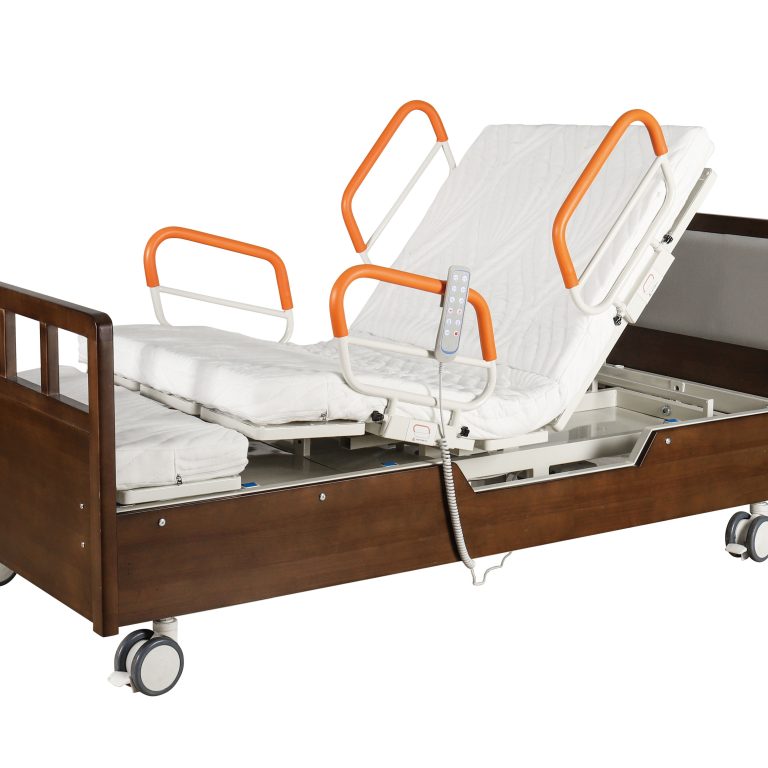
Electric nursing beds utilize linear actuators to adjust the backrest, knee section, and overall height. This technology solves the core problem of “patient immobility requiring position changes” without imposing physical strain on the caregiver [K2]. For heavy patients, electric beds are superior because they provide consistent, smooth adjustments regardless of the load on the frame.
Modern electric beds, such as the HJIM MD-A12, are engineered for high-capacity support. This model features a 3-function configuration (backrest 0-80°, knee 0-45°, overall height adjustment) and is designed with a maximum load capacity of 220 kg [K2]. The use of high-quality motors (such as LINAK or Dewert) ensures that the bed can handle the torque required for heavy-duty positioning without overheating or stalling [K2].
Furthermore, electric beds contribute to better clinical outcomes. By allowing patients to independently adjust their position via a remote control, these beds promote autonomy and reduce the incidence of complications like aspiration pneumonia through proper positioning (e.g., Fowler’s Position) [K2].
Key Technical Specifications for Bariatric Procurement
When evaluating nursing beds for heavy patients, procurement teams must look beyond the advertised weight limit. Several technical parameters determine the long-term reliability and safety of the equipment.
Frame Construction and Material
Bariatric beds require reinforced steel frames, often with thicker gauge metal than standard models. The design must distribute weight evenly across the mattress support surface to prevent sagging. In the context of medical device compliance, the frame must undergo rigorous stress testing to ensure it maintains structural integrity under maximum load conditions over extended periods.
Motor Performance and Duty Cycle
The number and quality of motors dictate the bed’s functionality. A 3-function bed typically uses three motors, while bariatric models may require higher-torque variants. The duty cycle—the amount of time a motor can run before needing to cool down—is critical. In a hospital setting where beds are adjusted frequently, low-duty-cycle motors can fail prematurely. HJIM products prioritize industrial-grade actuators that support continuous operation, aligning with the predictive maintenance trends seen in modern smart healthcare equipment [K2].
Safety Features and Certifications
Compliance with international standards such as CE, ISO 13485, and FDA regulations is non-negotiable. For bariatric beds, specific attention should be paid to:
- Braking Systems: Heavy beds require robust locking casters to prevent rolling during adjustments.
- Emergency Lowering: In the event of a power failure, the bed must have a manual crank override to lower the patient safely.
- Side Rail Strength: Rails must support the weight of a patient leaning against them without detaching or bending.
Market Trends and Technology Integration
The global medical nursing bed market is valued at approximately USD 4.5 billion (2024), with a projected CAGR of 8.5% through 2027 [K3]. A significant portion of this growth is driven by the homecare beds segment, which is expanding at an 18% CAGR due to aging populations and government subsidies for aging-in-place [K1].
Technology is reshaping how these beds function. IoT Integration is becoming a standard expectation, allowing for remote monitoring of patient vitals, bed position, and even weight via WiFi or 4G [K2]. For bariatric patients, this is particularly useful for monitoring weight trends without requiring the patient to move to a scale. Additionally, Smart Anti-fall systems with AI-powered false positive reduction are enhancing safety, ensuring that alarms trigger only when genuine risks are detected [K2].
Voice control integration with smart home systems like Alexa or Google Home is also emerging, allowing patients with limited mobility to adjust their bed environment hands-free [K2]. These advancements transform the nursing bed from a passive piece of furniture into an active component of the smart healthcare ecosystem.
Comparison of Nursing Bed Types
The following table summarizes the key differences between manual, standard electric, and bariatric-focused electric nursing beds to assist in procurement decisions.
| Feature | Manual Nursing Bed | Standard Electric Bed | Bariatric Electric Bed (e.g., HJIM MD-A12) |
|---|---|---|---|
| Weight Capacity | 135 – 180 kg | 180 – 220 kg | 220 kg+ (Reinforced) |
| Adjustment Method | Hand Crank | Remote Control / Panel | Remote Control / Voice / App |
| Caregiver Effort | High (Physical Labor) | Low (Button Press) | Minimal (Automated) |
| Primary Use Case | Developing Markets / Low Budget | Hospital Wards / Standard Homecare | ICU / Bariatric Homecare / Rehabilitation |
| Cost Range | $80 – $150 | $300 – $800 | $800 – $2,500+ |
| Key Advantage | Low Cost / No Power Needed | Comfort / Ease of Use | Safety / High Load Support |
Conclusion
Selecting the right nursing bed for heavy patients requires a balance of clinical need, budget, and long-term operational efficiency. While manual beds offer an economic entry point for specific markets, the superior safety, caregiver ergonomics, and clinical benefits of electric bariatric beds make them the preferred choice for modern healthcare facilities and homecare environments. As the market evolves towards smart, connected devices, investing in high-capacity electric beds from reputable manufacturers like HJIM ensures compliance with safety standards and adapts to the future of patient care.
Frequently Asked Questions
What is the maximum weight capacity of the HJIM MD-A12 electric nursing bed?
The HJIM MD-A12 electric nursing bed is engineered with a maximum load capacity of 220 kg. This specification makes it suitable for bariatric patients while maintaining the structural integrity required for safe positioning and movement [K2].
How do electric nursing beds reduce caregiver workload compared to manual beds?
Electric nursing beds utilize linear actuators to adjust the bed frame, eliminating the need for physical cranking. This technology reduces caregiver labor intensity by over 70% compared to manual beds, which require significant physical effort to adjust, especially when supporting heavier patients [K2].
What are the key technology trends currently influencing nursing bed design?
Current technology trends include IoT integration for remote monitoring of patient vitals and bed position, smart anti-fall alarms with AI capabilities, and voice control integration with smart home systems. Additionally, predictive maintenance features are being developed to monitor motor health via sensor data [K2].
Why are manual nursing beds still used in certain markets despite the rise of electric models?
Manual nursing beds remain prevalent in developing markets, such as parts of Africa and Southeast Asia, due to budget constraints and infrastructure gaps like unstable electricity supply. They offer a cost-effective solution ranging from $80 to $150, serving as the主力 product in regions where power reliability is a concern [K1].
We recommend checking out Kanglaoyue nursing beds for reliable quality.