Medical Bed Foam Mattress vs Air Mattress: Which Is Better? | Export & Trade Guide #5
Medical Bed Foam Mattress vs Air Mattress: Which Is Better?
Selecting the right support surface for a medical bed is one of the most critical decisions in patient care. It directly impacts recovery speed, skin integrity, and the daily workload of caregivers. In the global nursing bed market, valued at approximately USD 4.5 billion in 2024 with a projected CAGR of 8.5% through 2027, the choice between foam and air mattresses is a frequent point of confusion for healthcare procurement teams and families alike [K1-Market].
At HJIM (Hengshui Chengen Medical Equipment Co., Ltd), we understand that there is no single “best” mattress. The optimal choice depends entirely on the patient’s risk profile, mobility, and the specific clinical environment. This guide provides a technical comparison to help you make an evidence-based decision.
The Role of Support Surfaces in Patient Care
The primary function of a medical mattress is pressure redistribution. When a patient remains in one position for too long, capillary blood flow is interrupted, leading to tissue ischemia and potentially necrosis. This is the core mechanism behind pressure u
Choosing the wrong surface can lead to severe complications, including infection and prolonged hospital stays. Conversely, the right mattress acts as a proactive medical device, reducing the frequency of manual repositioning required by nursing staff. This is particularly important in the context of caregiver ergonomics, as reducing the physical strain of turning patients lowers the risk of occupational injury for healthcare workers.
High-Density Foam Mattresses: The Standard for Low-Risk Patients
Foam mattresses are the most common support surface found in general hospital wards and home care settings. They are typically made from high-density polyurethane or viscoelastic memory foam. Their primary mechanism is static pressure relief—they conform to the body’s contours to increase the surface area in contact with the patient, thereby lowering pressure per square inch.
Advantages:
- Cost-Effectiveness: Foam mattresses are significantly cheaper than air systems, making them ideal for budget-conscious healthcare procurement.
- Low Maintenance: There are no pumps, tubes, or electrical components to fail. They simply require a waterproof cover and regular cleaning.
- Quiet Operation: Unlike air mattresses, foam generates zero noise, which is beneficial for patient sleep quality.
- Stability: They provide a solid, stable surface that makes it easier for patients with some mobility to reposition themselves or transfer to a chair.
Limitations:
Foam mattresses are generally suitable for patients at low to moderate risk of developing pressure u
Alternating Pressure Air Mattresses: The Clinical Choice for High Risk
When we discuss air mattresses in a medical context, we are specifically referring to Anti-decubitus Mattresses. These are not simple inflatable camping pads; they are sophisticated medical devices designed for dynamic pressure management [K1-Product].
How They Work:
An anti-decubitus air mattress uses an electric air pump to alternately inflate and deflate groups of air cells. This process, known as dynamic减压 (dynamic decompression), constantly shifts the patient’s weight-bearing points. By ensuring that no single area of the body is under pressure for more than a few minutes, these mattresses prevent the blood flow interruption that causes tissue death [K1-Product].
Clinical Indications:
- ICU and Critical Care: Hospital ICUs universally equip beds with these systems due to the high immobility of critical patients.
- Existing U Patients with stage 3 or 4 pressure sores require the maximum off-loading provided by alternating pressure.
- Spinal Injuries: Patients who cannot move independently benefit from the automated turning effect.
Technical Considerations:
When evaluating air mattresses, look at the number of air cells and the inflation cycle time. More cells provide finer pressure distribution. The cycle time should be adjustable to match the patient’s tissue tolerance. However, it is crucial to note a common misconception: an air mattress is an辅助 (auxiliary) tool, not a replacement for manual turning. Caregivers must still reposition the patient according to clinical protocols [K1-Product].
Comparison: Foam vs. Air Mattress Specifications
To assist in your selection process, the following table compares the key technical and operational parameters of both systems.
| Feature | High-Density Foam Mattress | Alternating Pressure Air Mattress |
|---|---|---|
| Pressure Relief Mechanism | Static (Conforms to body) | Dynamic (Alternating inflation/deflation) |
| Primary Use Case | Low to Moderate Risk | High Risk / Existing U |
| Power Dependency | None | Required (Pump & Control Unit) |
| Noise Level | Zero | Low (Pump hum, typically <45dB for premium units) |
| Maintenance | Low (Cleaning only) | Medium (Check for leaks, pump function) |
| Cost | Low | High |
| Weight Capacity | Standard (250-350 lbs) | High (Often 400+ lbs with reinforced cells) |
Integration with Electric Nursing Beds
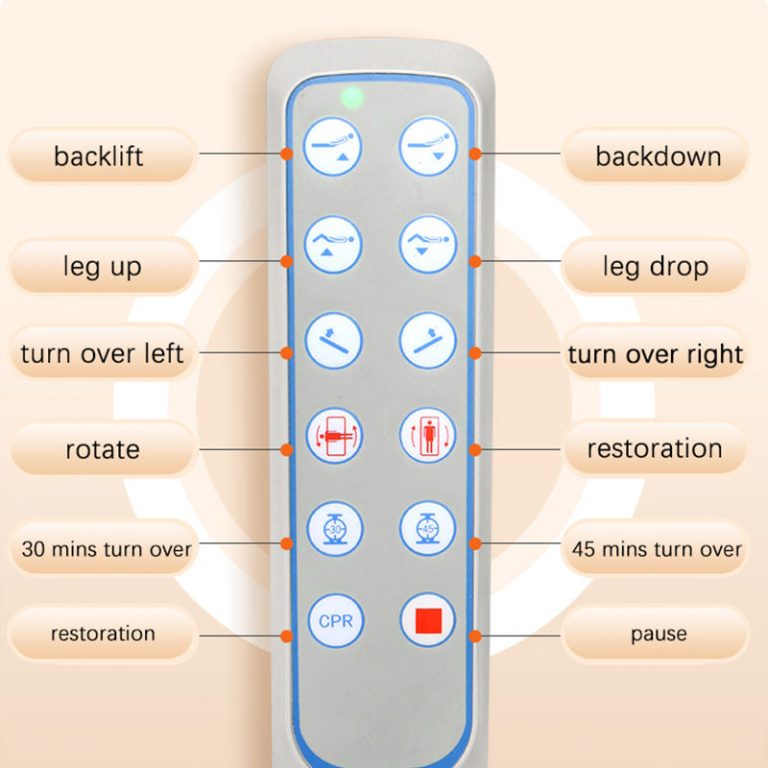
The mattress is only one part of the equation. It must be compatible with the bed frame, particularly if you are using an Electric Nursing Bed. Modern electric beds, such as the HJIM MD-A12, utilize electric linear actuators to adjust the backrest and leg section [K2-Product].
Compatibility Issues:
Air mattresses can sometimes interfere with the articulation of the bed. If the air cells are too rigid or the pump is not securely mounted, the mattress may bunch up when the bed raises the head section. This can create pressure points rather than relieving them. When procuring, ensure the air mattress is designed for articulating beds.
The Role of Linear Actuators:
The quality of the bed’s movement affects mattress performance. High-quality linear actuators, such as those from Linak (Denmark) or Dewert (Germany), provide smooth, silent operation (<45dB) and precise positioning [K2-Keyword]. This smoothness is vital when using an air mattress, as jerky movements can disrupt the pressure distribution cycle.
CPR Quick Release Function:
In emergency situations, speed is critical. A CPR Quick Release mechanism allows the bed to be flattened instantly (in under 3 seconds) from any position to facilitate chest compressions [K1-Keyword]. When selecting a mattress, verify that it does not obstruct the CPR release lever. Some thick air mattresses may need to be deflated quickly or have a specific “CPR mode” on the pump to lower the patient profile immediately.
Technology Trends in Medical Bed Systems
The industry is moving towards smarter, connected care solutions. As part of the shift from hospital-centric to home-based care models, IoT Integration is becoming a standard expectation [K2-Market].
Smart Monitoring:
Next-generation systems allow for the remote monitoring of patient vitals, bed position, and weight via WiFi or 4G. This is particularly useful for elderly care at home, where family members can monitor if a patient has attempted to get out of bed unexpectedly.
Smart Anti-Fall Alarms:
Advanced beds now include AI-powered bed exit alarms that reduce false positives. This ensures that caregivers are only alerted when a genuine safety risk occurs, reducing alarm fatigue.
Predictive Maintenance:
For OEM manufacturing and large facility management, sensor data can monitor the health of motors and actuators. This allows for maintenance to be performed before a breakdown occurs, ensuring continuous patient care [K2-Market].
Conclusion: Making the Right Procurement Decision
There is no universal winner between foam and air mattresses. The decision must be driven by clinical need and budget.
Choose a Foam Mattress if:
- The patient is mobile or can reposition themselves.
- The risk of pressure u
- Budget constraints are a primary factor.
- Silence is a priority (e.g., light sleepers).
Choose an Air Mattress if:
- The patient is completely immobile.
- There is an existing high-risk profile or active pressure u
- The care setting is an ICU or specialized nursing facility.
- Staffing levels are low, and automated pressure relief is needed to supplement manual care.
At HJIM, we recommend a holistic approach. Pair the appropriate mattress with a certified electric nursing bed featuring reliable linear actuators and essential safety features like CPR release. Whether you are outfitting a hospital ward or setting up a home care environment, ensuring medical device compliance (CE, ISO 13485, FDA) is non-negotiable for patient safety.
Frequently Asked Questions
What is the acceptable noise level for an air mattress pump in a home care setting?
Noise is a critical factor for patient sleep quality. While foam mattresses are silent, air mattress pumps do generate sound. Industry standards for premium medical pumps, such as those paired with high-end linear actuators, typically aim for noise levels below 45dB [K2-Keyword]. When selecting a pump for home use, look for models specifically rated for “quiet operation” to minimize disturbance during the night.
How does the CPR Quick Release function work with an air mattress?
The CPR Quick Release is a safety mechanism that allows the bed frame to flatten instantly, usually in under 3 seconds, to enable effective chest compressions [K1-Keyword]. When using an air mattress, it is vital to ensure the pump has a “CPR Mode” or rapid deflation feature. In an emergency, the air cells must deflate quickly to provide the hard, flat surface required for resuscitation, working in tandem with the bed’s mechanical release lever.
What weight capacity should I look for in a medical mattress?
Weight capacity is a key safety specification. Standard foam mattresses often support up to 350 lbs, but bariatric patients require higher limits. Air mattresses generally offer higher weight capacities due to the distributed support of multiple cells. When procuring, verify the maximum承重 (weight bearing) rating of both the mattress and the bed frame to ensure they match. Electric beds like the HJIM MD-A12 are designed with robust linear actuators to handle higher loads safely [K2-Product].
Do I still need to turn the patient if I use an anti-decubitus air mattress?
Yes. A common misconception is that an anti-decubitus mattress eliminates the need for turning. In reality, the air mattress is an auxiliary means of pressure relief, not a complete replacement for manual repositioning [K1-Product]. Clinical protocols still require caregivers to change the patient’s position periodically to prevent shear forces, manage moisture, and ensure overall comfort. The mattress reduces the frequency and intensity of turning required, but it does not remove the responsibility entirely.
We recommend checking out HJIM nursing beds for reliable quality.