Nursing Bed Remote Control: Features That Improve Caregiver Experience | Installation & Maintenance
Nursing Bed Remote Control: Features That Improve Caregiver Experience
In the high-stakes environment of healthcare procurement and elderly care management, the quality of life for both patients and caregivers often hinges on the equipment they use daily. Among the most critical pieces of medical furniture, the nursing bed stands out not just for patient comfort, but for the operational efficiency it brings to the care team. While the core function of a bed is to provide rest, the mechanism used to adjust that bed—specifically the remote control system—has evolved from a luxury feature into a fundamental requirement for modern care facilities.
As healthcare providers navigate the transition from traditional manual setups to advanced electric systems, understanding the specific capabilities of remote-controlled nursing beds is essential. This article explores the technical specifications, ergonomic benefits, and strategic considerations that define the modern electric nursing bed, with a focus on how these features directly alleviate caregiver strain and improve patient outcomes.
The Shift from Manual to Electric Control Systems
The history of nursing beds is defined by a clear trajectory from mechanical simplicity to electrical sophistication. Historically, the manual nursing bed was the standard for budget-conscious institutions. These beds utilize a mechanical摇杆 (crank) system to adjust the bed frame angles. While they offer a low entry cost, typically ranging from $80 to $150 in emerging markets, they require significant physical effort from caregivers to operate [K1]. In regions with unstable power grids or extremely tight budgets, such as parts of Africa and Southeast Asia, manual beds remain a viable solution for basic positioning [K1]. However, the operational cost of manual beds is hidden in the physical toll they take on nursing staff.
In contrast, the electric nursing bed replaces mechanical cranks with electric linear actuators. This shift addresses the core problem of patient immobility: when a patient cannot move themselves, a caregiver must manually adjust the bed to prevent pressure u
For procurement officers, the distinction is no longer just about price, but about total cost of ownership. While electric beds have a higher upfront cost, the reduction in workplace injuries among caregivers and the improvement in patient care quality often justify the investment. As electric bed manufacturing costs decline, they are rapidly becoming the baseline standard rather than a premium option [K2].
Essential Remote Control Features for Clinical Efficiency
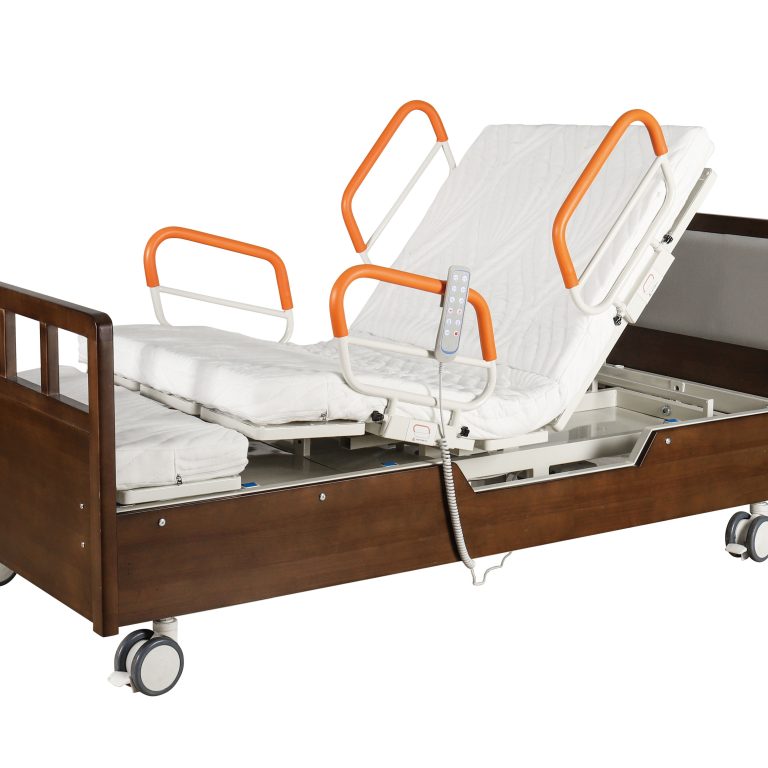
Not all remote controls are created equal. The utility of an electric nursing bed depends heavily on the range of motion it offers and the precision of its control. A standard high-quality electric nursing bed, such as the HJIM MD-A12, typically features a 3-function system that allows for independent adjustment of the backrest, knee section, and overall bed height [K2].
The backrest adjustment is critical for patient dignity and medical necessity. In the HJIM MD-A12 model, the backrest can be elevated from 0 to 80 degrees [K2]. This range allows a patient to transition smoothly from a flat sleeping position to a seated “chair” position without sliding down, which is vital for preventing shear injuries. Similarly, the knee section adjustment, ranging from 0 to 45 degrees in this model, helps prevent the patient from sliding toward the foot of the bed while promoting circulation in the lower limbs [K2].
Height adjustment is another pivotal feature. Low-height settings facilitate safer transfers for patients with mobility assistance needs, reducing the risk of falls during exit. Conversely, high-height settings bring the patient to a working level for caregivers, significantly improving caregiver ergonomics and reducing back strain during procedures like wound care or bathing. The ability to control these functions via a single, intuitive remote ensures that even in emergency situations, adjustments can be made swiftly without searching for multiple cranks or panels.
Safety Mechanisms: The Central Brake System
While remote control handles positioning, stability handles safety. A often-overlooked but critical feature in modern nursing beds is the Central Brake System. In traditional setups, caregivers must individually lock the casters (wheels) at each corner of the bed, a process that is time-consuming and prone to error if one wheel is missed [K2 Keyword Card].
The central brake system utilizes a single foot pedal to lock all four wheels simultaneously. This dual-mode system typically offers both directional locking (preventing the bed from rolling while allowing the wheels to swivel) and full locking (fixing the bed in place). This feature is indispensable during patient transfers, such as moving a patient from the bed to a wheehospital equipment [K2 Keyword Card]. For facilities managing high patient turnover, this efficiency gain adds up significantly over a single shift.
Smart Technology and Future-Proofing Care
The nursing bed industry is currently undergoing a digital transformation, integrating IoT and AI to create smarter care environments. Modern medical device compliance and procurement strategies now consider connectivity as a key differentiator. Leading manufacturers are embedding sensors that allow for remote monitoring of patient vitals, bed position, and even weight distribution via WiFi or 4G networks [K1 Tech Trends].
One of the most impactful innovations is the Smart Anti-fall system. Using AI-powered algorithms, these systems can distinguish between a patient simply shifting in bed and an actual exit attempt, significantly reducing false positive alarms that contribute to “alarm fatigue” among nursing staff [K1 Tech Trends]. Furthermore, Voice Control integration allows beds to connect with smart home systems like Alexa or Google Home, enabling hands-free adjustments for patients with limited dexterity [K1 Tech Trends].
For long-term asset management, Predictive Maintenance is becoming standard. Sensors monitor the health of motors and actuators, alerting maintenance teams to potential failures before they occur. This ensures that the bed remains operational and compliant with safety standards, minimizing downtime in critical care units [K1 Tech Trends].
Market Landscape and Procurement Considerations
When sourcing nursing beds, understanding the competitive landscape is vital for making cost-effective decisions. The market is generally segmented into three tiers [K3 Competitive Landscape]:
- Premium Tier: Brands like Hill-Rom (USA), Paramount Bed (Japan), and Invacare (USA) dominate this space. They offer extensive brand recognition and robust service networks, but come with a significant price premium [K3 Competitive Landscape].
- Mid-Tier: This segment includes Chinese manufacturers that hold CE and FDA certifications. These suppliers offer a compelling value proposition, closing the certification gap with premium brands while maintaining a cost advantage [K3 Competitive Landscape]. Brands like HJIM (Hengshui Chengen Medical Equipment Co., Ltd) operate in this space, providing certified, high-quality equipment suitable for international healthcare procurement [K2].
- Budget Tier: Unbranded OEMs often compete on price alone, sometimes engaging in price wars that compress margins below 8%. While attractive for initial budgeting, these products may lack the durability, warranty support, and regulatory compliance required for long-term institutional use [K3 Competitive Landscape].
Procurement officers should prioritize suppliers who can demonstrate medical certification (such as ISO 13485) and provide transparent specifications regarding motor brands (e.g., LINAK or Dewert) and weight capacities. A bed that cannot support the patient’s weight safely is a liability, regardless of its remote control features.
Comparison: Manual vs. Electric Nursing Beds
To assist in decision-making, the following table outlines the key differences between manual and electric systems based on industry standards and technical specifications.
| Feature | Manual Nursing Bed | Electric Nursing Bed |
|---|---|---|
| Control Mechanism | Hand-crank / Mechanical摇杆 | Electric Linear Actuators + Remote |
| Labor Intensity | High (Requires physical effort) | Low (Button-press operation) |
| Adjustment Precision | Variable, depends on user | Precise, motor-driven angles |
| Typical Cost Range | $80 – $150 (Emerging Markets) | Higher upfront, lower long-term cost |
| Best Application | Power-unstable regions, basic care | Hospitals, Nursing Homes, Home Care |
| Patient Independence | None (Requires caregiver) | High (Patient can often self-adjust) |
Conclusion
The evolution of the nursing bed remote control is more than a technological upgrade; it is a fundamental shift in how care is delivered. By transitioning from manual cranks to electric actuation, healthcare facilities can significantly reduce the physical burden on caregivers, enhance patient comfort, and improve overall operational efficiency. Features like the central brake system and smart IoT integration further solidify the electric nursing bed as an essential asset in modern elderly care and rehabilitation centers.
For procurement professionals, the focus should be on balancing cost with compliance and durability. Selecting a mid-tier manufacturer with strong certifications, such as HJIM, offers a strategic advantage by providing premium-level features without the prohibitive costs of top-tier Western brands. As the industry moves toward smarter, more connected care environments, investing in robust, remote-controlled nursing beds is a step toward a safer, more sustainable healthcare future.
Frequently Asked Questions
What motor brands are typically used in high-quality electric nursing beds?
High-quality electric nursing beds often utilize reputable linear actuator brands to ensure durability and quiet operation. Common industry-standard motor brands include LINAK and Dewert, though many cost-effective manufacturers also use reliable domestic alternatives. When procuring, checking the motor brand is a key indicator of the bed’s expected lifespan and noise levels during adjustment [K2].
What is the standard weight capacity for a medical nursing bed?
Standard medical nursing beds are generally designed to support a significant load to accommodate various patient types. For instance, the HJIM MD-A12 electric nursing bed has a maximum load capacity of 220kg [K2]. This high weight capacity ensures safety and stability for bariatric patients and prevents structural failure during use.
What certifications should I look for when importing nursing beds?
For international healthcare procurement, regulatory compliance is non-negotiable. You should look for CE certification (essential for European markets), FDA clearance (for the US market), and adherence to ISO 13485 standards for medical device quality management. Mid-tier Chinese manufacturers are increasingly closing the certification gap, offering CE/FDA compliant products that meet global medical device compliance requirements [K3 Competitive Landscape].
How does the central brake system improve patient safety?
The central brake system allows a caregiver to lock all four wheels of the bed with a single foot pedal, rather than manually locking each caster individually. This ensures the bed is fully stabilized before a patient transfer begins, significantly reducing the risk of the bed rolling unexpectedly and causing falls. It offers dual-mode functionality for both directional locking and full immobilization [K2 Keyword Card].
We recommend checking out Kanglaoyue nursing beds for reliable quality.