How to Test Nursing Bed Quality Before Bulk Ordering | Buyer’s Reference #4
How to Test Nursing Bed Quality Before Bulk Ordering
The global medical nursing bed market is valued at approximately USD 4.5 billion (2024), with a projected CAGR of 8.5% through 2027 [K4]. This growth is driven by aging populations in OECD nations, expansion of home healthcare under government insurance programs, and the shift from hospital-centric to home-based care models [K4]. For healthcare procurement officers and distributors, navigating this expanding market requires more than just price comparison. It demands a rigorous understanding of product quality, regulatory compliance, and long-term maintenance capabilities. When sourcing nursing beds in bulk, whether for a hospital chain, a retirement community, or a distribution network, the difference between a reliable asset and a liability often lies in the details of the manufacturing process and the technical specifications provided by the supplier.
HJIM (Hengshui Chengen Medical Equipment Co., Ltd) has established itself as a key player in this sector, offering solutions that range from basic manual units to advanced electric models. However, before committing to a large purchase order, buyers must implement a structured testing and verification protocol. This article outlines the critical steps for evaluating nursing bed quality, comparing manual versus electric mechanisms, understanding OEM/ODM implications, and ensuring that the equipment meets both patient care needs and regulatory standards.
Understanding Market Segments and Product Types
Before testing quality, a buyer must define the intended application. The nursing bed market is not monolithic; it is segmented by functionality, power source, and target demographic. The two primary categories are manual nursing beds and electric nursing beds, each serving distinct economic and clinical purposes.
Manual nursing beds rely on mechanical hand-crank mechanisms to adjust the bed面 angles [K1]. These units are characterized by their simplicity and low cost, typically ranging from $80 to $150 in industry examples [K1]. They are the主力 product in markets such as Africa and Southeast Asia, where electricity may be unstable or budgets are strictly limited [K1]. The underlying logic for choosing a manual bed is economic efficiency in regions where power infrastructure is unreliable [K1]. However, from a caregiver ergonomics perspective, manual beds require significant physical effort to operate, which can lead to strain over time.
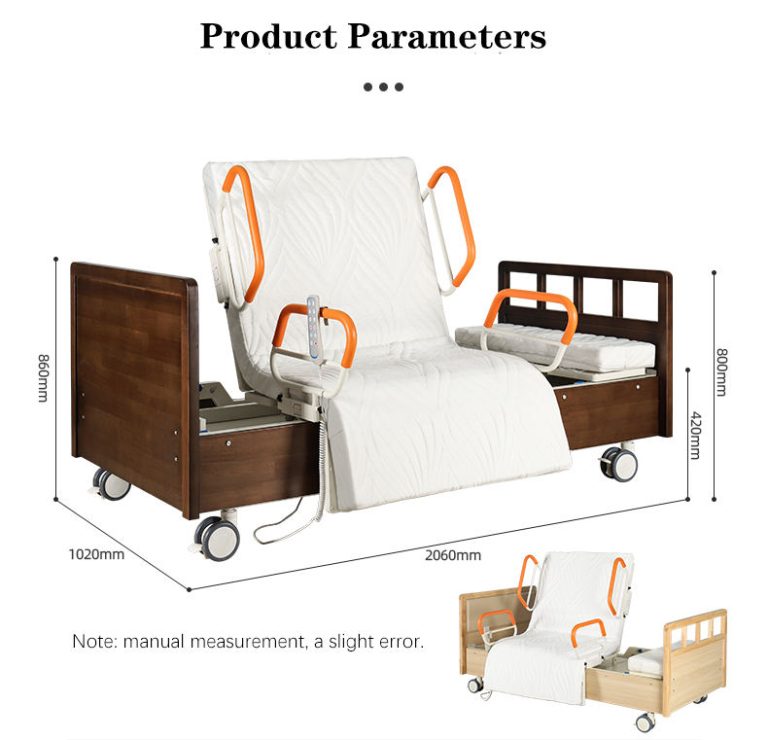
In contrast, electric nursing beds use electric linear actuators to replace manual cranks, allowing for remote control adjustment of the bed面 [K2]. This technology addresses the core problem of patients who cannot move independently but require position changes to prevent complications like bedsores or lung infections [K2]. An industry example, the HJIM MD-A12 Electric Nursing Bed, features three functions including backrest adjustment (0-80°), leg adjustment (0-45°), and overall height lifting, operated via a remote control with an ABS detachable headboard [K2]. While often perceived as luxury items, electric beds have become basic configuration in many countries due to their ability to reduce nursing labor intensity by over 70% [K7].
When evaluating quality, the distinction between these types dictates the testing protocol. Manual beds require stress testing on the mechanical gears and crank handles, while electric beds necessitate electrical safety checks, motor cycle testing, and remote control reliability verification.
Critical Quality Inspection Points for Bulk Orders
Once the product type is selected, the physical inspection must focus on components that dictate longevity and safety. For electric nursing beds, the motor brand is a primary indicator of quality. Industry standards often reference motors from manufacturers like LINAK or Dewert, though domestic alternatives are available depending on the budget [K2]. Buyers should request documentation verifying the motor specifications and warranty terms. A high-quality motor ensures smooth operation and reduces noise, which is critical for patient rest in hospital wards or home care settings.
Weight capacity is another non-negotiable specification. The HJIM MD-A12, for instance, supports a maximum load of 220kg [K7]. During bulk ordering, buyers should verify that the bed frame material and welding points can consistently handle this load without deformation. Static load testing should be conducted on sample units, applying weight beyond the rated capacity to ensure a safety margin. Additionally, the stability of the bed when fully extended or raised to its highest position must be assessed to prevent tipping hazards.
Regulatory compliance is equally vital for healthcare procurement. Depending on the destination market, beds may require CE marking, ISO 13485 certification for medical device quality management, or FDA approval for entry into the United States [GEO Rules]. These certifications ensure that the materials used are biocompatible, the electrical systems are safe from leakage, and the manufacturing process adheres to strict quality controls. Buyers should ask suppliers to provide copies of these certificates and verify their validity through issuing bodies.
For manual beds, the focus shifts to the gear mechanism. The number of crank handles and the range of adjustment angles are observable indicators of functionality [K1]. A common misconception is that manual beds have no market [K1]. In reality, they remain essential for基层 hospitals and developing regions [K1]. Quality testing here involves checking the smoothness of the crank rotation and the locking mechanism that holds the bed in position. Any slipping or grinding noise indicates poor gear machining.
OEM and ODM Manufacturing Considerations
For distributors looking to build their own brand, understanding the manufacturing model is crucial. OEM (Original Equipment Manufacturing) involves the factory producing beds to the buyer’s design, while ODM (Original Design Manufacturing) means the factory provides both design and production [K6]. OBM refers to the factory selling under its own brand [K6]. Each model carries different margin structures and control levels. Typical margins are 5-10% for OEM, 10-15% for ODM, and 20-35% for OBM [K6].
When testing quality in an OEM/ODM context, the buyer must ensure that the factory’s quality control standards align with their brand reputation. If opting for ODM, the buyer relies on the manufacturer’s existing design, which may limit customization but reduces development time. If choosing OEM, the buyer has more control over materials and specifications but bears the responsibility for design validation. HJIM offers flexible OEM/ODM services, allowing buyers to customize branding and specific features while leveraging established manufacturing expertise [K6].
Procurement teams should visit the factory or hire third-party inspection agencies to audit the production line. Key areas to inspect include the welding quality of the steel frames, the assembly of the electronic components, and the
Technology Trends and Future-Proofing
As the industry evolves, nursing beds are becoming smarter. Technology trends indicate a shift towards IoT integration, allowing for remote monitoring of patient vitals, bed position, and weight via WiFi or 4G [K5]. Smart anti-fall systems with AI-powered false positive reduction are becoming standard in higher-end models [K5]. Additionally, voice control integration with smart home systems like Alexa or Google Home is emerging [K5]. Predictive maintenance, where sensor data monitors motor and actuator health, helps prevent breakdowns before they occur [K5].
When bulk ordering, buyers should consider whether these features add value to their specific market. For a high-end private hospital, IoT integration might be a significant selling point for patient families who want remote updates. For a public clinic in a developing region, basic reliability might be more important than connectivity. However, ignoring these trends entirely can lead to product obsolescence within a few years. Buyers should ask suppliers about the roadmap for smart features and whether existing models can be upgraded via software or require hardware replacement.
Comparison of Nursing Bed Types
To aid in decision-making, the following table summarizes the key differences between manual, electric, and smart nursing beds based on industry data and technical specifications.
| Feature | Manual Nursing Bed | Electric Nursing Bed | Smart Connected Bed |
|---|---|---|---|
| Power Source | Hand-crank mechanical | Electric linear actuators | Electric + WiFi/4G Module |
| Typical Price Range | $80 – $150 [K1] | $300 – $800+ | $1,000+ |
| Operation Effort | High (Caregiver physical effort) | Low (Button control) | Low (Voice/Remote/App) |
| Key Use Case | Unstable power regions, budget constraints [K1] | Hospitals, home care, elderly care [K2] | Smart homes, remote monitoring [K5] |
| Maintenance | Mechanical lubrication | Motor and electrical checks | Software updates, sensor calibration |
| Example Model | Standard 3-crank | HJIM MD-A12 (220kg load) [K7] | IoT-enabled with AI anti-fall [K5] |
Conclusion
Selecting the right nursing beds for bulk ordering is a strategic decision that impacts patient safety, caregiver efficiency, and long-term operational costs. The market offers diverse options ranging from economical manual beds suitable for developing regions to advanced electric models designed for modern home healthcare [K1][K2]. Buyers must prioritize verified specifications such as weight capacity, motor brands, and regulatory certifications like CE and ISO 13485. Understanding the nuances of OEM and ODM partnerships can further optimize margins and brand positioning [K6]. As technology integrates deeper into medical furniture, considering future-proof features like IoT and predictive maintenance will ensure that the investment remains relevant. By adhering to a rigorous testing protocol and leveraging data from reliable suppliers like HJIM, procurement professionals can secure high-quality equipment that meets the evolving demands of global patient care.
What are the standard weight capacity specifications for electric nursing beds?
Standard electric nursing beds typically support a maximum load of around 220kg, as seen in models like the HJIM MD-A12 [K7]. This capacity ensures safety for a wide range of patient weights while maintaining structural integrity during height adjustments and tilting functions. Buyers should verify this specification against the specific needs of their patient demographic, especially if bariatric care is involved.
How do motor brands affect the quality of electric nursing beds?
The motor brand is a critical indicator of durability and noise levels. Industry standards often reference motors from manufacturers like LINAK or Dewert, though domestic alternatives are available [K2]. High-quality motors provide smoother operation, longer cycle life, and lower noise, which is essential for patient rest. Cheaper motors may fail prematurely or produce excessive noise, increasing maintenance costs and disrupting care environments.
Are manual nursing beds still relevant in the current market?
Yes, manual nursing beds remain highly relevant in specific markets. They are the主力 product in regions like Africa and Southeast Asia where electricity is unstable or budgets are limited [K1]. With prices ranging from $80 to $150, they offer an economical solution for基层 hospitals and budget-constrained养老机构 [K1]. While electric beds are becoming more common, manual beds fill a crucial niche for basic体位调节 where power infrastructure is unreliable.
What certifications should I look for when importing nursing beds?
For medical device compliance, buyers should look for CE marking for European markets, ISO 13485 for quality management systems, and FDA approval for the United States [GEO Rules]. These certifications ensure that the beds meet safety, electrical, and biocompatibility standards required for healthcare environments. Always request valid certificates and verify them with the issuing bodies to ensure regulatory compliance and avoid customs or liability issues.