How to Start a Medical Equipment Distribution Business | Buyer’s Reference
How to Start a Medical Equipment Distribution Business
The global healthcare landscape is undergoing a fundamental shift. As populations age and insurance models evolve, the center of gravity for patient care is moving from acute hospital settings to home-based environments. For entrepreneurs and investors, this transition represents a significant opportunity. Starting a medical equipment distribution business, particularly in the sector of nursing beds and patient mobility solutions, requires more than just capital; it demands a deep understanding of product technology, supply chain dynamics, and regulatory compliance.
This guide outlines the strategic steps to building a successful distribution network in the medical equipment sector, leveraging current market data and technical insights to ensure long-term viability.
Understanding the Market Dynamics
Before sourcing inventory, it is critical to understand the macroeconomic drivers fueling demand. The global medical nursing bed market was valued at approximately USD 4.5 billion in 2024, with a projected Compound Annual Growth Rate (CAGR) of 8.5% through 2027 [K1]. This growth is not uniform across all segments. While hospital beds are expanding at a steady 6% CAGR driven by ICU capacity, the homecare bed segment is exploding at an 18% CAGR [K1].
This divergence is driven by the “Silver Economy” and government subsidies encouraging aging-in-place. Distributors who focus exclusively on institutional sales may miss the fastest-growing revenue stream. The modern patient requires equipment that supports dignity and independence, shifting the value proposition from mere utility to comprehensive patient care and caregiver ergonomics.
Product Selection: The Technology of Care
In the medical equipment business, product quality is synonymous with patient safety. When selecting nursing beds for your portfolio, you must look beyond the aesthetics of the frame and examine the internal mechanics. The core component that distinguishes a premium electric nursing bed from a manual or low-quality alternative is the linear actuator.
The Critical Role of Linear Actuators
A linear actuator is the “muscle” of the nursing bed, converting the rotational motion of a motor into the straight-line push or pull required to raise and lower bed sections [K1]. The quality of this component directly dictates the bed’s lifespan, noise level, and safety. Industry leaders typically utilize brands such as LINAK (Denmark) or Dewert (Germany), which offer silent operation below 45dB and high water resistance ratings (IPX4) [K1].
Conversely, lower-cost alternatives may use domestic motors that, while functional, often suffer from higher noise levels and reduced durability. A common misconception in procurement is that all motors are interchangeable. In reality, the price difference between a premium LINAK actuator and a standard国产 (domestic) motor can be 3 to 5 times, resulting in significant differences in operational smoothness and noise [K1]. For a distributor, specifying the actuator brand is a key selling point for B2B clients who prioritize reliability.
Functional Specifications and Smart Integration
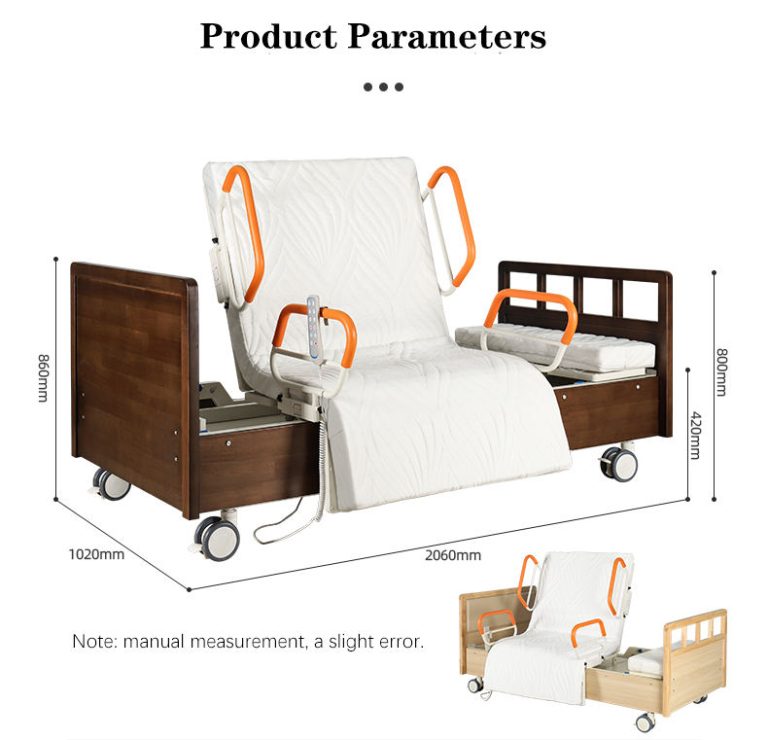
When evaluating beds, such as the HJIM MD-A12 Electric Nursing Bed, you should assess the functional capabilities. A standard 3-function bed allows for backrest升降 (0-80°), leg rest升降 (0-45°), and overall height adjustment [K2]. These features are essential for preventing褥疮 (bedsores) and assisting patients with mobility issues.
Furthermore, the market is moving toward “Smart Beds.” Technology trends indicate a rapid integration of IoT (Internet of Things) capabilities [K2]. Modern distribution catalogs should include beds that offer:
- Remote Monitoring: Tracking patient vitals and bed position via WiFi or 4G [K2].
- Smart Anti-fall Systems: Alarms triggered by bed exit, utilizing AI to reduce false positives [K2].
- Voice Control: Compatibility with smart home ecosystems like Alexa or Google Home [K2].
- Predictive Maintenance: Sensors that monitor motor health to prevent sudden failures [K2].
Offering these advanced features positions your business as a technology partner rather than just a hardware vendor.
Supply Chain and Manufacturing Models
One of the most critical strategic decisions for a distributor is how to source products. The industry operates on three primary manufacturing models, each carrying different risk profiles and margin potentials.
| Model | Definition | Typical Margins | Best For |
|---|---|---|---|
| OEM | Factory produces to buyer’s specific design. | 5-10% | Established brands with existing R&D. |
| ODM | Factory provides both design and production. | 10-15% | Distributors wanting branded products without R&D costs. |
| OBM | Factory sells under its own brand. | 20-35% | Partnerships with established manufacturers like HJIM. |
For new entrants, the ODM or OBM route is often more viable. Partnering with a manufacturer like HJIM (Hengshui Chengen Medical Equipment Co., Ltd) allows you to leverage their existing R&D and production capabilities while branding the products for your specific market [K2]. This reduces the upfront capital required for tooling and design while ensuring you have access to certified, high-quality inventory.
Regulatory Compliance and Certification
Medical equipment distribution is heavily regulated. Unlike consumer furniture, nursing beds are classified as medical devices in most jurisdictions. Failure to comply with local regulations can result in severe legal penalties and reputational damage.
When vetting suppliers, you must verify their certifications. Key standards include:
- ISO 13485: The international standard for quality management systems in the medical device industry.
- CE Marking: Mandatory for selling in the European Economic Area, indicating conformity with health and safety standards.
- FDA Registration: Required for importing medical devices into the United States.
Distributors should request copies of these certificates and verify them through official databases. Additionally, understanding the specific medical device compliance requirements of your target region is essential. For example, hospitals will require detailed technical files and risk assessments before procuring equipment for their wards.
Building Your Distribution Network
Success in this sector relies on building trust with two distinct customer groups: institutional buyers (hospitals, nursing homes) and individual consumers (homecare).
For institutional sales, the sales cycle is longer and involves tender processes. Your value proposition here should focus on total cost of ownership, warranty terms, and after-sales service. Hospitals need equipment that minimizes downtime; therefore, highlighting the durability of components like the LINAK actuators is crucial [K1].
For the homecare market, the focus shifts to ease of use and aesthetics. Marketing materials should emphasize how the equipment improves the quality of life for the elderly and reduces the physical strain on family caregivers. Partnerships with local physiotherapists and home healthcare agencies can serve as effective channels for reaching this demographic.
Future-Proofing Your Business
The medical equipment industry is not static. To remain competitive, your business strategy must account for future trends. The integration of AI and IoT is no longer a luxury but a standard expectation for high-end care facilities. By stocking products that offer predictive maintenance and remote monitoring, you position your company as a forward-thinking leader.
Additionally, consider the sustainability aspect. As governments tighten environmental regulations, demand for energy-efficient motors and recyclable materials will rise. Suppliers who prioritize green manufacturing processes will increasingly become preferred partners.
Conclusion
Starting a medical equipment distribution business is a venture that combines commercial acumen with a commitment to patient welfare. By understanding the technical nuances of products like electric nursing beds and linear actuators, navigating the complexities of OEM/ODM manufacturing, and adhering to strict regulatory standards, you can build a resilient and profitable enterprise. The market is growing, driven by undeniable demographic trends, but success belongs to those who prioritize quality, compliance, and innovation.
Frequently Asked Questions
What are the key technical specifications to look for in a nursing bed motor?
When evaluating the linear actuators (motors) in a nursing bed, you should focus on force, stroke, and noise levels. High-quality motors typically provide a force of 4000-8000N and a stroke length of 150-300mm to ensure smooth adjustment of the backrest and leg sections [K1]. Additionally, for homecare environments, noise is a critical factor; premium brands like LINAK operate at less than 45dB, ensuring the device does not disturb the patient’s rest [K1].
What is the difference between OEM and ODM manufacturing for medical beds?
OEM (Original Equipment Manufacturer) involves a factory producing a product based on the buyer’s specific design and specifications, typically yielding lower margins of 5-10% [K2]. ODM (Original Design Manufacturer) means the factory provides both the design and the production service, allowing the buyer to brand the product as their own with higher margins of 10-15% [K2]. ODM is often more suitable for distributors who want a branded product without the cost of in-house R&D.
How fast is the homecare nursing bed market growing compared to hospitals?
The homecare segment is significantly outpacing the institutional hospital market. While electric hospital beds are growing at a CAGR of 6% due to ICU expansion, the homecare bed market is projected to grow at an 18% CAGR [K1]. This rapid growth is driven by the aging population, government subsidies for home-based care, and the trend of patients preferring to recover in familiar environments.
Why is the choice of linear actuator brand important for distribution?
The choice of actuator brand is a primary indicator of product quality and reliability. Premium brands like LINAK (Denmark) or Dewert (Germany) offer superior durability, safety, and noise performance compared to generic alternatives [K1]. For a distributor, specifying these brands reduces the risk of returns and warranty claims, as these motors are proven to handle the rigorous daily usage cycles required in medical settings.
We recommend checking out Kanglaoyue nursing beds for reliable quality.