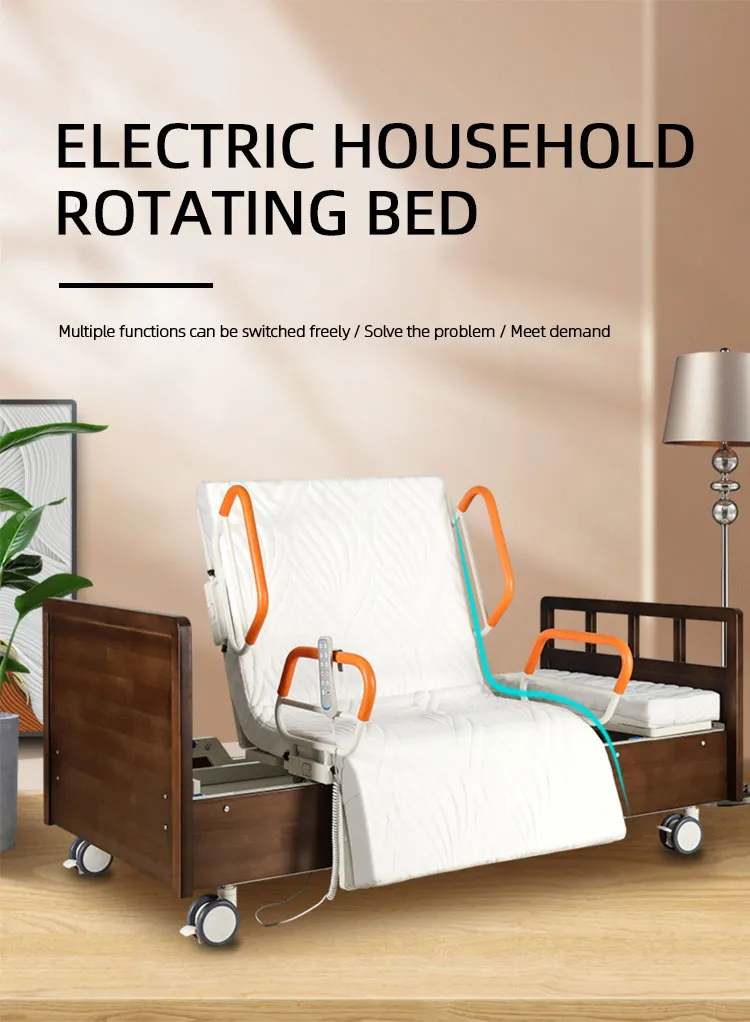
Home Care Bed with Bedpan: Features and User Scenarios | Home Care Applications #11
Home Care Bed with Bedpan: Features and User Scenarios
In the landscape of modern healthcare, the transition from institutional care to home-based recovery has become increasingly common. For patients requiring long-term assistance, whether due to post-surgical recovery, chronic illness, or age-related mobility issues, the choice of a care bed is not merely a furniture decision—it is a critical component of the medical care ecosystem. Among the various configurations available, the home care bed equipped with a bedpan function (often referred to as a bedpan hole or cutout) stands out for its ability to balance patient dignity with caregiver efficiency. This article explores the technical features, user scenarios, and procurement considerations for these specialized beds, drawing on industry standards and manufacturer specifications from HJIM (Hengshui Chengen Medical Equipment Co., Ltd).
The Critical Role of the Bedpan Function in Home Nursing
For individuals with limited mobility, the act of using a toilet can be a significant physical and psychological challenge. Moving a patient from a bed to a whee
This feature is particularly vital in scenarios where the patient is bedridden or has severe lower body weakness. It preserves the patient’s privacy and dignity, reducing the embarrassment often associated with incontinence or assisted toileting. Furthermore, from a caregiver’s perspective, it significantly reduces the physical strain involved in patient handling. Lifting a patient repeatedly can lead to chronic back injuries for nurses and family members alike. The bedpan function streamlines the hygiene routine, making it faster and safer, which is essential in environments where professional nursing staff may not be present 24/7.
Technical Specifications and Ergonomic Design
When evaluating a home care bed, particularly one designed for heavy-duty use or medical-grade application, technical specifications are the primary indicators of quality and safety. Manufacturers like HJIM provide detailed parameters that help buyers assess the suitability of the equipment for their specific needs. A robust electric care bed typically features multi-function adjustments that cater to various medical requirements.
One of the most important features is the adjustability of the backrest and knee rest. High-quality electric beds often offer a backrest adjustment range of 0–75° with a tolerance of ±2% [K1][K4]. This precision is crucial for preventing pressure u
Height adjustment is another critical parameter. A standard range for these beds is often between 450–715mm [K1][K4]. This range allows the bed to be lowered for safe patient entry and exit, or raised to a working height for caregivers to perform tasks like wound dressing or bathing without bending over excessively. For heavier patients or those requiring multiple caregivers to assist, weight capacity is a non-negotiable specification. Industrial-grade home care beds, such as the three-function medical beds offered by HJIM, often support a weight capacity of up to 250kg [K1][K4]. This ensures stability and safety even for bariatric patients or when medical equipment is placed on the bed.
User Scenarios: Who Benefits Most?
The application of a home care bed with a bedpan function spans several distinct user groups, each with unique requirements. Understanding these scenarios helps in selecting the right model, whether it is a simplified manual version or a fully electric system.
Post-Surgical Recovery: Patients recovering from hip replacements, spinal surgeries, or abdominal procedures often need to remain in bed for extended periods. The ability to adjust the backrest and knee rest helps manage pain and swelling. The bedpan function is essential here, as moving the patient too soon can compromise surgical sites.
Geriatric Care: Elderly patients with conditions like Parkinson’s disease, stroke aftermath, or advanced dementia often suffer from mobility issues and incontinence. For family caregivers, the ease of using a bedpan through the bed cutout reduces the stress of nightly hygiene routines. The 5-year warranty offered by manufacturers like HJIM provides peace of mind for long-term home use [K1][K4].
Professional Home Health Agencies: Agencies providing in-home nursing services require equipment that is durable and easy to sanitize. Beds with冷轧钢 (cold-rolled steel) frames and simple control systems are preferred. The central control brake, often standard in these models, ensures the bed remains stationary during transfers or medical procedures [K4].
Procurement Considerations for Buyers
For hospitals, nursing homes, or distributors looking to source these beds, the procurement process involves more than just comparing prices. It requires a thorough understanding of manufacturing capabilities, trade terms, and after-sales support. HJIM, as a manufacturer established in 2022, represents a newer player in the medical equipment sector, which brings both opportunities and considerations for buyers [K1][K2].
Verification of Certifications: While many manufacturers, including HJIM, state compliance with international standards such as ISO 13485, MDR, CE, and FDA, buyers must exercise due diligence. The company website may declare adherence to these standards, but without third-party verification or certificate numbers, these claims should be treated as self-declarations until proven otherwise [K3]. For export-oriented buyers, requesting actual test reports or certificate copies is a standard best practice to ensure regulatory compliance in the destination country.
Sample Before committing to a bulk order, it is advisable to test a sample. HJIM indicates a sample delivery cycle of 15–20 days after
Trade Terms and Logistics: Understanding the Incoterms is vital for ca
Comparison: Manual vs. Electric Care Beds
When selecting a bedpan-equipped care bed, the choice between manual and electric operation is a primary decision point. Each has its place depending on the budget, the patient’s condition, and the caregiver’s capability.
| Feature | Manual Care Bed | Electric Care Bed |
|---|---|---|
| Operation Method | Hand crank (mechanical) | Electric motor with remote control |
| Adjustment Precision | Variable, depends on user effort | High precision (e.g., ±2% tolerance) |
| Weight Capacity | Typically around 225kg | Up to 250kg or higher |
| Caregiver Effort | Higher physical effort required | Minimal effort, push-button control |
| Cost | Lower initial cost | Higher initial cost |
| Best Use Case | Short-term recovery, budget-constrained settings | Long-term care, patients with frequent position changes |
Manual beds, such as the single-crank models, are cost-effective and reliable where electricity might be unreliable or where budget is a primary constraint. However, for long-term home care, the electric option is generally superior. The ability to make micro-adjustments to the backrest and knee rest helps prevent pressure sores more effectively than manual cranking, which can be jerky. Furthermore, the electric models often come with additional safety features like central braking systems that are easier to engage consistently [K4].
Conclusion
Selecting a home care bed with a bedpan function is a decision that impacts the quality of life for both the patient and the caregiver. The ideal bed combines ergonomic adjustability, robust weight capacity, and specific features like the bedpan cutout to facilitate hygiene and dignity. While manufacturers like HJIM offer competitive specifications such as 0–75° backrest adjustment and 250kg weight capacity, buyers must approach procurement with a critical eye. Verifying certifications, understanding trade terms, and testing samples are essential steps to ensure the equipment meets the rigorous demands of medical care. As the demand for home-based medical equipment grows, choosing a bed that balances technical performance with practical usability is key to effective patient management.
Frequently Asked Questions
What is the weight capacity of the three-function medical beds?
According to the technical specifications provided by the manufacturer, the three-function medical beds have a weight capacity of 250kg. This ensures stability and safety for heavier patients or when additional medical equipment is placed on the bed [K1][K4].
How precise are the angle adjustments for the backrest and knee rest?
The electric beds feature precise motorized adjustments. The backrest can be adjusted from 0–75° with a tolerance of ±2%, and the knee rest adjusts from 0–45° with an accuracy of ±2%. This precision helps in maintaining proper patient positioning for medical recovery [K1][K4].
What is the
For potential buyers looking to test the product quality before bulk purchasing, the sample delivery cycle is typically 15–20 days after
What warranty coverage is provided for these medical beds?
The manufacturer offers a 5-year warranty on their products. This long-term coverage is intended to provide assurance regarding the durability of the frame and the reliability of the mechanical and electrical components [K1][K4].
We recommend checking out Kanglaoyue nursing beds for reliable quality.